Inside the Handala Hack: How 200,000 Corporate Devices Were Wiped in Minutes
In March 2026, the global cybersecurity landscape was shaken by a highly disruptive incident attributed to the Handala hacker group. The threat actor claimed responsibility for a massive cyber operati

In March 2026, the global cybersecurity landscape was shaken by a highly disruptive incident attributed to the Handala hacker group. The threat actor claimed responsibility for a massive cyber operation targeting a prominent multinational enterprise, asserting that they had successfully compromised the organization’s centralized device management systems to execute a synchronized remote wipe command. This destructive event resulted in the sudden, widespread factory-resetting of corporate laptops and mobile devices, showcasing a dangerous shift where standard IT management utilities are weaponized directly against an organization’s internal infrastructure.
This incident has critical implications for Microsoft Intune security and the broader discipline of enterprise endpoint management. Because modern businesses rely heavily on cloud-based Mobile Device Management (MDM) platforms to manage and secure thousands of remote assets, a compromise of these management planes bypasses traditional perimeter defenses entirely. For organizations in the healthcare sector and critical infrastructure partners, the sudden loss of access to operational endpoints introduces profound business disruptions, exposing severe vulnerabilities in privileged access, identity security, and overall cyber resilience.
In this detailed analysis, we will deconstruct the reported Stryker cyberattack and evaluate the strategic risks associated with privileged account takeover in cloud management environments. Readers will gain an understanding of how administrative “remote wipe” functions can be abused, examine the distinction between verified facts and unconfirmed attacker claims, and learn actionable defensive strategies on how to secure Microsoft Intune and Microsoft Entra ID against destructive identity-based threats.
What Is the Handala Hacker Group?

The Handala hacker group is an active threat actor that first emerged in December 2023, utilizing pro-Palestinian and nationalist branding while carrying out aggressive cyber operations primarily targeting Israeli entities and select Western organizations. Named after an iconic cultural caricature representing Palestinian resilience, the group has historically conducted a mix of ransomware, website defacements, data exfiltration, and large-scale psychological operations. In March 2026, the United States Department of Justice officially connected the group to the Iranian government, identifying it as a state-sponsored front operating under the direction of Iran’s Ministry of Intelligence and Security (MOIS) to project influence and execute disruptive cyber warfare.
What Happened in the Reported Stryker Cyberattack?
On March 11, 2026, Michigan-based medical technology giant Stryker Corporation experienced a severe global disruption to its internal Microsoft systems, which the company subsequently confirmed was a contained cyber incident. While Stryker reported that it found no immediate evidence of malware or traditional ransomware within its environment, the Handala hacker group claimed credit on Telegram and X for infiltrating Stryker’s administrative console. Independent reports and threat intelligence analyses suggest that the attackers leveraged compromised administrative credentials to gain unauthorized access to the company’s device management platform. From this privileged vantage point, the threat actors reportedly initiated unauthorized commands that forced a substantial number of employee devices to reset to factory defaults, causing localized operational bottlenecks in order processing, manufacturing, and general corporate communications.
The 200,000 Devices Claim: Confirmed Fact or Attacker Claim?
Following the initial breach, the Handala hacker group claimed that they had successfully wiped more than 200,000 corporate devices globally. It is critical to recognize that this 200,000 figure remains an unverified attacker claim, with external cybersecurity firms and independent journalists offering conflicting numbers. Some security analysts estimated that the actual number of disrupted devices was closer to 80,000, while Stryker itself has not publicly validated either figure or provided an official tally of affected endpoints. In the aftermath of high-profile security incidents, state-aligned groups routinely exaggerate the physical and operational impact of their campaigns as part of a psychological operations strategy designed to inflate their technical capabilities and amplify public anxiety.
The 50TB Data Claim and Data Exfiltration Risk
Alongside the destructive wiping claims, Handala asserted that they exfiltrated 50 terabytes (TB) of sensitive corporate data from the target network prior to triggering the factory resets. As with the device count, this massive exfiltration volume remains unverified by third-party forensic firms or official company statements. Data exfiltration remains a primary objective for state-linked actors operating in the healthcare and medical technology sectors, where intellectual property, regulatory compliance records, and employee personal information represent high-value targets. To properly address these double-extortion tactics, organizations must conduct deep, multi-layered forensic investigations of network egress logs and cloud storage audit trails to validate the actual scope of any alleged data theft before making public declarations.
How Microsoft Intune Remote Wipe Can Become a Security Risk
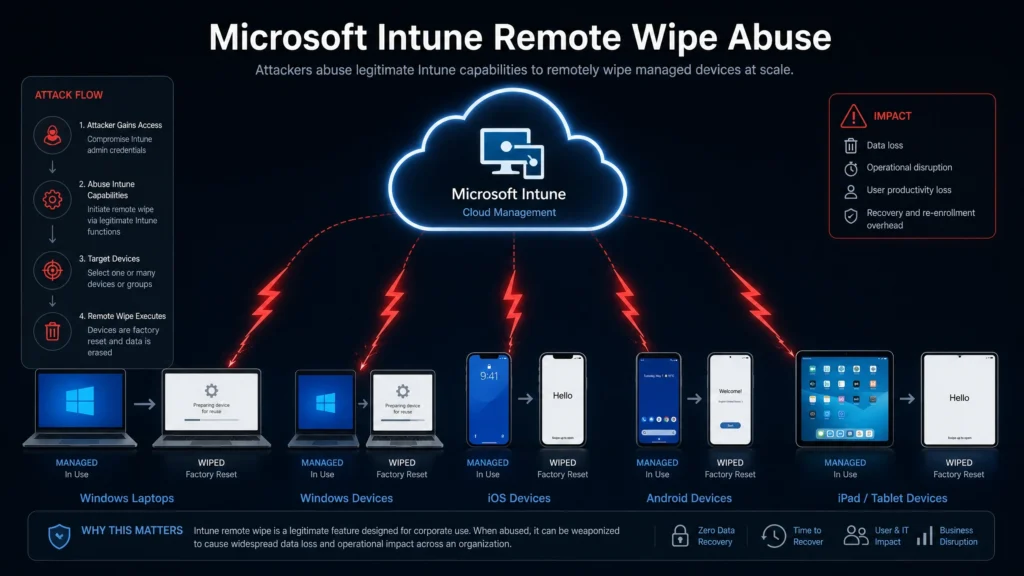
Cloud-managed Mobile Device Management (MDM) tools, such as Microsoft Intune, are designed to streamline corporate IT operations by providing a centralized command console to configure, update, and protect distributed endpoints. One of their core capabilities is the remote wipe command, which allows IT administrators to securely erase corporate laptops, tablets, and smartphones that are lost, stolen, or decommissioned. However, this “single pane of glass” also introduces a highly critical consolidation of administrative authority. If threat actors manage to compromise the administrative plane of an MDM environment, they can abuse these legitimate remote management capabilities to initiate mass factory resets across the entire fleet of enrolled devices, transforming a critical security feature into a highly destructive tool of operational erasure.
Why Privileged Access Is the Core Risk
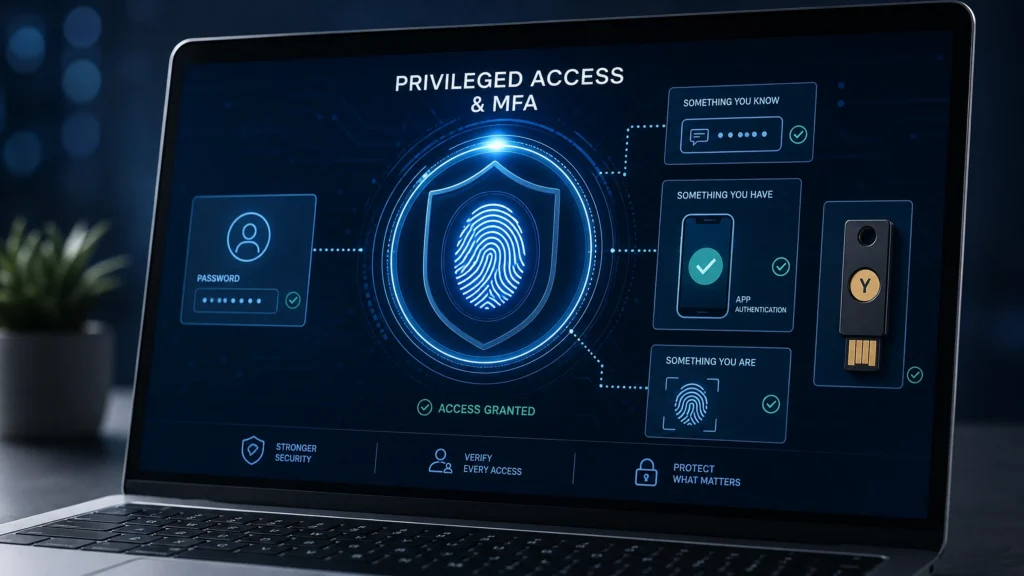
The technical root cause of management plane abuse is almost never a vulnerability in the software itself, but rather a failure of identity security and access management. When highly privileged administrator accounts—specifically Global Administrator or Intune Administrator roles—lack robust security controls, they become the ultimate targets for identity-based attacks. Threat actors exploit weak or absent multi-factor authentication (MFA), bypass inadequate conditional access policies, or harvest credentials through sophisticated phishing and social engineering campaigns. Once inside a single privileged session, an attacker possesses the authorized credentials necessary to bypass standard endpoint defenses, allowing them to initiate mass destructive commands without ever needing to deploy malware or bypass local antivirus agents.
Microsoft Intune Security Lessons From the Incident
1. Protect Global Administrator Accounts
Global Administrator accounts in Microsoft Entra ID hold absolute authority over an organization’s entire tenant and cloud ecosystem. These accounts must be strictly restricted to an absolute minimum of highly trained personnel, separate from standard, daily-use email accounts. To mitigate the risk of continuous exposure, organizations should enforce Just-In-Time (JIT) access through Privileged Identity Management (PIM), require phishing-resistant multi-factor authentication (MFA), and establish closely monitored, offline emergency “break-glass” accounts to maintain control during an active tenant compromise.
2. Use Role-Based Access Control
Implementing Role-Based Access Control (RBAC) ensures that administrators are granted only the minimum permissions necessary to perform their specific job functions. For instance, full Intune Administrator rights should not be distributed casually; instead, tier-based administrative roles should be created to separate device enrollment, policy configuration, and destructive operations like remote wipe. By limiting the number of identities authorized to execute wipe or retire commands, organizations can drastically reduce the blast radius of a single compromised administrative identity.
3. Enforce Conditional Access and MFA
Conditional Access policies act as the primary dynamic firewall for identity security in the Microsoft cloud environment. Security teams must enforce strict, location-based, risk-based, and device-compliant sign-in rules that immediately block access from unusual geolocations or non-compliant devices. Multi-factor authentication (MFA) must be mandated for all users, with a strong preference for phishing-resistant methods, such as FIDO2 security keys or Microsoft Authenticator with number matching, to thwart modern session hijacking and adversary-in-the-middle attacks.
4. Monitor Audit Logs and Sign-In Logs
Continuous visibility is the cornerstone of proactive threat detection in a Microsoft environment. Security operations centers (SOC) must ingest Microsoft Entra ID sign-in logs and Intune audit logs into a centralized security information and event management (SIEM) system. Automated alerting rules should be configured to flag unusual administrative behavior, such as rapid changes to device compliance policies, anomalous sign-ins from unexpected administrative IP addresses, or a sudden spike in initiated remote wipe actions.
5. Secure BYOD and Personal Devices
Bring Your Own Device (BYOD) policies introduce distinct risk surfaces because personal, corporate-connected smartphones, tablets, and personal laptops often lack the strict endpoint controls applied to corporate-owned hardware. Security teams should enforce clear enrollment restrictions within Microsoft Intune, separating corporate data from personal data using application protection policies (MAM) rather than giving full device management access. By structuring device enrollment policies with granular boundaries, organizations can prevent malicious or unauthorized wiping of an employee’s personal device while securing corporate assets.
6. Test Incident Response for Endpoint Wipe Scenarios
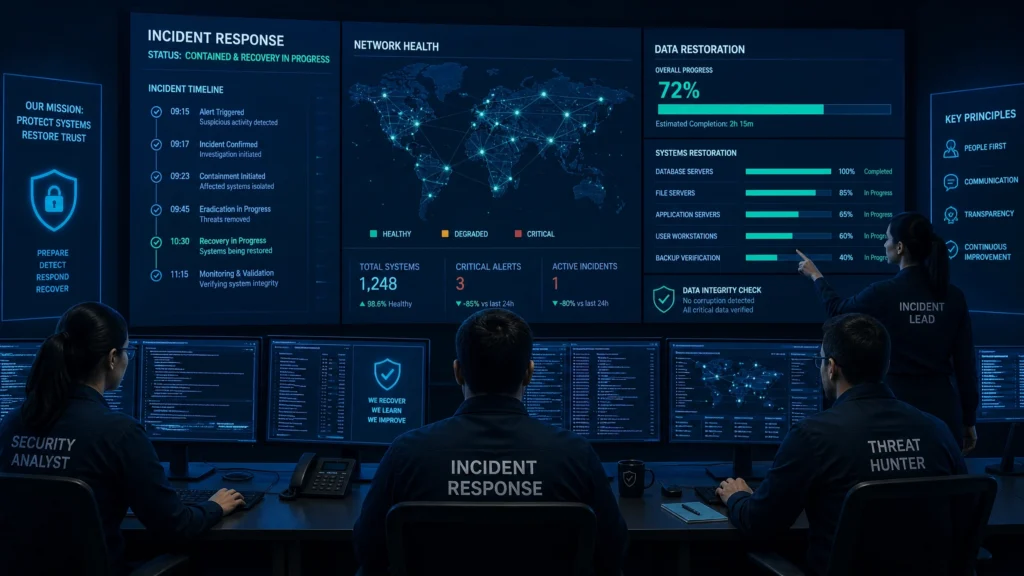
Most organizations design their incident response (IR) plans around malware outbreaks or localized network breaches, leaving them unprepared for the rapid, mass erasure of hundreds of corporate endpoints. IR teams must actively conduct tabletop exercises that simulate a compromised MDM console initiating a massive remote wipe command. These scenarios must address how to safely isolate the tenant, re-establish administrative control, and physically or remotely recover thousands of wiped machines when standard communication channels on those devices are entirely severed.
7. Build Endpoint Backup and Recovery Plans
A robust backup strategy is the ultimate line of defense against destructive wiping campaigns. Critical data stored on corporate laptops and endpoints must be continuously backed up to secure, cloud-hosted repositories or isolated endpoint backup solutions. In the event of an authorized or unauthorized factory reset, having reliable, tested, and offline disaster recovery paths ensures that employees can quickly rebuild their operating environments and restore local business continuity without permanent data loss.
8. Detect Unusual Admin Behavior
Threat detection strategies must look beyond traditional indicators of compromise (IOCs) to focus heavily on user and entity behavior analytics (UEBA). A legitimate administrator account suddenly executing a high volume of administrative tasks outside of standard working hours, or modifying critical device enrollment configurations, represents highly anomalous behavior. SOC teams must design behavioral baselines for all privileged roles, establishing automatic lockouts or high-priority escalations when administrative actions deviate from established norms.
How to Secure Microsoft Intune
To fully understand how to secure Microsoft Intune, organizations must pivot from a model of operational convenience to a framework of Zero Trust. Hardening the Microsoft Intune console requires a multi-layered security approach that begins with auditing current role-based access control (RBAC) permissions to restrict the delegation of destructive tasks. Organizations must implement Microsoft Entra Privileged Identity Management (PIM) to require multi-step approval, time-bound access, and clear business justification before any user can activate administrative roles. Furthermore, enforcing strict device enrollment restrictions, blocking personal device enrollment unless explicitly approved, establishing rigid device compliance policies, and configuring immediate security alerts for bulk device wipes or retire commands will ensure that unauthorized administrative actions are identified and halted before they can inflict widespread damage.
Microsoft Entra ID and Identity Security Controls
Because Microsoft Intune relies entirely on Microsoft Entra ID (formerly Azure AD) for identity verification, securing the underlying identity management plane is the most critical factor in preventing cloud-based attacks. Identity security controls must enforce strong access management by configuring comprehensive Conditional Access policies that analyze user, device, and location risk in real time. Privileged Identity Management (PIM) must be utilized to eliminate persistent admin rights, while continuous monitoring of sign-in logs and audit logs must be integrated with behavioral analytics to detect active credential abuse. By establishing Entra ID as a hardened, Zero Trust identity boundary, security teams can effectively isolate their cloud administration tools from compromised user endpoints.
Could This Be Considered a Wiper Attack?
A classic wiper attack involves the deployment of specialized malware, such as HermeticWiper or Shamoon, designed to physically corrupt the master boot record or delete files on a local disk to make the operating system unbootable. In the reported Stryker cyberattack, the threat actors achieved an identical operational outcome without ever deploying malware, instead abusing the legitimate, native remote wipe function within Microsoft Intune. Because the end result is the rapid, total, and permanent destruction of local corporate data and device configurations across a global network, this method of administrative console abuse is widely classified by cybersecurity researchers as a modern, living-off-the-cloud variation of a destructive wiper attack.
Why Healthcare and Medical Technology Companies Are High-Value Targets
The global healthcare sector and medical technology companies represent extraordinarily attractive targets for sophisticated threat actors due to their critical role in public safety and the highly time-sensitive nature of their operations. Medical device manufacturers and healthcare organizations maintain complex supply chains, managing shipping operations, manufacturing lines, and order processing that directly support patient care. Disruptions to these critical infrastructure pathways can result in immediate, severe consequences, forcing organizations to face immense pressure to resolve incidents quickly. This operational urgency, combined with the valuable intellectual property and highly regulated patient data they manage, makes them prime targets for state-aligned groups seeking to maximize strategic, economic, or geopolitical impact.
Iran Cyberattack US 2026: What Attribution Really Means
Attributing a sophisticated incident like the reported Iran cyberattack US 2026 requires rigorous, evidence-based forensic analysis from government agencies, major telecommunications providers, and cybersecurity intelligence firms. While the Handala hacker group publicly frames its operations as localized, independent hacktivism, official declarations by the U.S. Department of Justice have formally linked their operations to Iran’s Ministry of Intelligence and Security (MOIS). In modern hybrid warfare, nation-states frequently employ decentralized front groups or “hacktivist personas” to establish plausible deniability while conducting highly disruptive cyber operations that align with their state interests. Security teams must focus on defending against the actual tactics, techniques, and procedures (TTPs) of these actors, recognizing that attribution is a complex geopolitical process that should not distract from immediate defensive patching and system hardening.
What Security Teams Should Check Immediately
- Review Global Administrator accounts
- Enforce MFA on all privileged users
- Enable conditional access policies
- Review Intune RBAC permissions
- Audit remote wipe permissions
- Check Microsoft Entra ID sign-in logs
- Review Intune audit logs
- Monitor device compliance policy changes
- Check suspicious device enrollment activity
- Validate backup and disaster recovery plans
- Review BYOD policies
- Run incident response tabletop exercises
- Confirm SOC alerting for privileged actions
- Investigate unusual admin behavior
- Document recovery procedures for wiped devices
Microsoft Intune Security Checklist
- Use least privilege access
- Use role-based access control
- Enable privileged identity management
- Require phishing-resistant MFA for admins
- Restrict Global Administrator usage
- Separate admin accounts from daily-use accounts
- Review device wipe permissions regularly
- Alert on mass wipe actions
- Monitor policy changes
- Secure device enrollment
- Enforce device compliance
- Protect BYOD environments
- Review audit logs weekly
- Test endpoint backup recovery
- Maintain an incident response plan
What Businesses Can Learn From the Handala Hack
The reported compromise of Stryker’s endpoint management platform serves as a powerful reminder that identity is the new corporate perimeter. Businesses must recognize that their internal IT management infrastructure, designed for efficiency, can quickly become a critical vector of self-inflicted destruction if left unprotected. Relying solely on local antivirus software or endpoint detection and response (EDR) is insufficient when threat actors possess the authorized administrative keys to bypass these defenses directly through the cloud. Going forward, organizations must treat Mobile Device Management consoles with the highest tier of security, prioritizing rigorous identity controls, testing disaster recovery protocols specifically for bulk endpoint loss, and maintaining a critical, verified mindset when analyzing high-profile cyberattack claims.
Final Thoughts
The reported Handala hacker group campaign against Stryker Corporation exposes a critical truth of the cloud era: centralized management tools represent both an enterprise’s greatest efficiency and its most devastating single point of failure. The claim that thousands of corporate devices were wiped in minutes illustrates that traditional, malware-centric security strategies are no longer sufficient to stop modern, identity-based threats. Achieving true cyber resilience requires a comprehensive shift toward Zero Trust architectures, where least privilege access, role-based access control, phishing-resistant multi-factor authentication, and deep administrative monitoring are enforced continuously. By learning from this incident, implementing rigorous identity security controls, and validating disaster recovery plans, modern enterprises can successfully defend their digital environments and maintain operational continuity in an increasingly hostile threat landscape.