AI Declared #1 Global Cybersecurity Threat
The rapid integration of artificial intelligence into enterprise and consumer technologies has fundamentally altered the global risk landscape, establishing the AI cybersecurity threat 2026 as a premi

The rapid integration of artificial intelligence into enterprise and consumer technologies has fundamentally altered the global risk landscape, establishing the AI cybersecurity threat 2026 as a premier concern for organizations worldwide. What was once considered a speculative, future threat has rapidly materialized as a daily operational reality, with adversaries utilizing advanced generative models to discover vulnerabilities, orchestrate highly tailored campaigns, and challenge traditional defense mechanisms. This shift is driving a dramatic re-evaluation of global cyber risk, as both businesses and geopolitical actors recognize that AI is not just a productivity tool, but an incredibly potent force multiplier for cybercriminals.
As organizations navigate this evolving landscape, the proliferation of AI phishing attacks, deepfake cyber fraud, and AI malware generation has dramatically lowered the technical barriers required to launch sophisticated, multi-stage cyber campaigns. Automated cyberattacks are no longer limited to basic scripting; instead, they now leverage autonomous AI agents capable of performing rapid reconnaissance, shifting tactics on the fly, and bypassing static defense perimeters. The consequences of these developments are widespread, presenting critical challenges to brand reputation, financial stability, and public trust across almost every major economic sector.
To help your organization navigate this complex terrain, this deep-dive analysis explores the core findings of the landmark WEF cybersecurity report 2026, dissects the most pressing AI-driven attack vectors, and outlines actionable cyber resilience strategies. We will also examine how organizations can bridge the critical cybersecurity skills gap, implement robust AI governance frameworks, and prepare for the long-term horizon of quantum computing encryption risk. By understanding both the offensive threats and the defensive capabilities of modern AI, technology executives can build a proactive posture capable of safeguarding digital trust.
Why AI Is Becoming a Major Cybersecurity Threat in 2026
Artificial intelligence has transitioned from a supporting asset to the central engine of modern cyber warfare, fundamentally accelerating both the speed and personalization of digital attacks. By leveraging generative AI, large language models (LLMs), and highly specialized AI agents, threat actors can bypass traditional security filters that rely on recognizable signatures or predictable attack patterns. The core danger lies in democratization: highly sophisticated cybercrime capabilities, such as writing polymorphic code or crafting bespoke social engineering lures, are now accessible to low-skilled attackers at a microscopic marginal cost. This scale and speed, combined with the capability of autonomous AI agents to dynamically probe networks for vulnerabilities, have effectively rendered legacy, manual threat-detection methods obsolete, transforming cybersecurity into a high-speed, machine-versus-machine arms race.
What the WEF Cybersecurity Report Says
The World Economic Forum’s newly released Global Cybersecurity Outlook 2026, published in collaboration with Accenture, highlights AI as the single most disruptive force in the digital ecosystem, with 94% of surveyed leaders identifying it as the primary driver of cybersecurity change. While some headlines claim AI has been officially labeled the “#1 global cybersecurity threat,” the report’s actual data presents a more nuanced reality: an unprecedented 87% of executives flagged AI-related vulnerabilities as the fastest-growing cyber risk. Furthermore, the WEF report reveals a widening disconnect between corporate governance and front-line security, noting that while chief information security officers (CISOs) remain heavily focused on systemic threats like ransomware and supply chain resilience, chief executive officers (CEOs) have officially ranked cyber-enabled fraud and AI-powered phishing as their top operational concerns. Alarmingly, the report also notes that while 64% of organizations now assess the security of AI tools before deployment—up significantly from 37% in the previous year—nearly one-third still operate with absolutely no formal AI risk assessment protocols, exposing massive blind spots in global supply chains.
AI Cybersecurity Threat 2026: Key Risks Businesses Face
To defend against the modern threat landscape, enterprises must first understand the specific technical methods adversaries are using to breach corporate perimeters and exploit human vulnerabilities. In 2026, the spectrum of AI-fueled risks is highly diverse, spanning external social engineering schemes, code-level exploits, internal data governance failures, and long-term cryptographic challenges. From targeted deepfake identity theft to shadow AI tools used by employees, these threats require a multi-layered security strategy that goes beyond standard anti-malware software.
Top AI Cyber Threats in 2026
1. AI Phishing Attacks
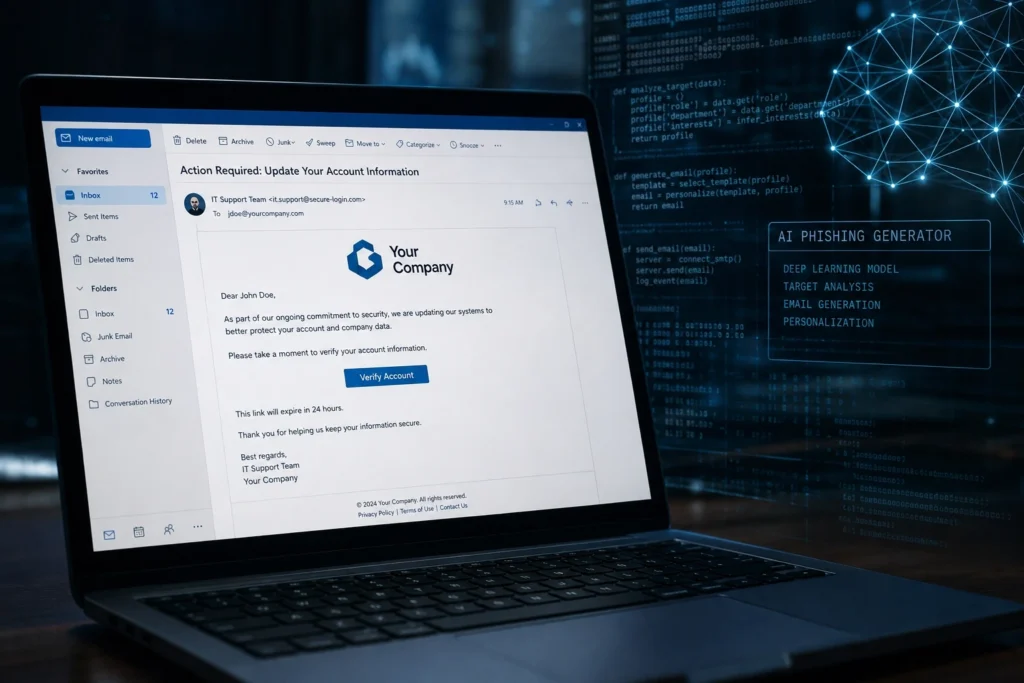
AI phishing attacks have redefined the nature of social engineering by completely eliminating the grammatical errors, awkward phrasing, and generic templates that historically exposed fraudulent emails. Using generative AI, attackers can instantly analyze public data, social media profiles, and stolen corporate communications to draft highly personalized, context-aware phishing emails in dozens of languages. These AI-generated lures are deployed at a scale previously impossible, yielding significantly higher click-through rates and successfully tricking even highly trained, security-conscious employees.
2. Deepfake Cyber Fraud

Deepfake cyber fraud has emerged as a multi-million-dollar threat to corporate treasuries, utilizing advanced synthetic media and real-time voice cloning to bypass traditional identity verification. Fraudsters can capture a few seconds of an executive’s voice from public webinars or media appearances, train a highly realistic voice model, and call financial team members to authorize urgent wire transfers. In some extreme cases, bad actors have even deployed real-time video deepfakes during virtual board meetings, leading to severe financial losses, executive impersonation, and business email compromise.
3. AI Malware Generation
AI malware generation allows attackers to write, optimize, and continuously mutate malicious code to evade signature-based endpoint detection. While speculative claims of fully autonomous, self-writing AI viruses are often exaggerated, security analysts confirm that LLMs are actively used by cybercriminals to find bugs in standard software and accelerate the development of custom ransomware. By using AI to automate the creation of minor code variations, developers of malware can ensure their payloads remain entirely undetected by legacy anti-virus tools.
4. Business Email Compromise and Identity Theft
Business email compromise (BEC) has been supercharged by generative AI, allowing threat actors to seamlessly mimic the distinct writing style, tone, and formatting of senior executives and trusted vendors. By feeding historic email threads into customized LLMs, attackers can insert themselves into ongoing business negotiations, issuing highly convincing, forged invoices that result in massive payment fraud. This highly precise form of identity theft erodes digital trust and makes it incredibly difficult for partners to distinguish legitimate financial requests from automated scams.
5. Prompt Injection Attacks
Prompt injection represents a critical security vulnerability unique to generative AI integrations, search tools, and autonomous AI agents. By feeding malicious instructions disguised as normal user queries or hiding them within external documents, attackers can override an LLM’s safety guardrails, forcing it to execute unauthorized commands. This can result in the exposure of sensitive proprietary data, unauthorized API calls, and the manipulation of automated workflows connected to corporate databases.
6. Data Poisoning and Model Manipulation
Data poisoning and model manipulation threaten the core integrity of the machine learning systems that modern enterprises rely on for automated decision-making. Through adversarial AI techniques, attackers can inject corrupted data into public or private training sets, subtly altering how a model behaves. This can cause security systems to misclassify malware as benign, disrupt algorithmic trading, or compromise the accuracy of critical analytics models used by corporate boards.
7. Shadow AI Inside Organizations
Shadow AI has rapidly become a major internal governance challenge, as employees frequently upload sensitive corporate data, source code, and customer information into unapproved public AI tools. Without proper corporate oversight, these practices lead to accidental data leaks, violation of strict privacy regulations like GDPR, and potential intellectual property exposure. Organizations must maintain visibility over all AI tools deployed on their networks to prevent compliance failures and maintain strict data security.
8. Automated Cyberattacks at Scale
Automated cyberattacks leverage machine learning and automated scripts to systematically scan global networks, identify unpatched vulnerabilities, and execute exploits in real time. This automated reconnaissance allows threat actors to orchestrate massive, highly synchronized campaigns targeting thousands of organizations simultaneously, overwhelming manual security operations centers (SOCs). By scaling up attack speed, cybercriminals can penetrate corporate networks long before human defenders can initiate patch management protocols.
9. Quantum Computing Encryption Risk
Quantum computing encryption risk is a looming systemic threat that could compromise the mathematical foundations of modern digital security. While fully operational, cryptographically relevant quantum computers are still several years away, experts warn of “harvest now, decrypt later” tactics, where adversaries steal encrypted sensitive data today to decrypt it once quantum capabilities mature. Organizations must immediately begin transitioning to post-quantum cryptography (PQC) to protect long-term data security, replacing legacy RSA and ECC encryption standards before the physical threat materializes.
How AI Is Also Improving Cyber Defense
While artificial intelligence has undoubtedly supercharged offensive cybercrime, it remains an equally vital tool for modern cyber defense, helping organizations achieve faster threat detection and response. AI-powered security systems can analyze billions of global data points in real time, identifying micro-anomalies in user behavior, network traffic, and endpoint activity that would otherwise go unnoticed by human analysts. By automating repetitive tasks within the security operations center (SOC), machine learning models can instantly isolate compromised devices, deploy temporary firewall rules, and accelerate vulnerability management. This predictive capability shifts the defensive paradigm from reactive incident response to proactive threat hunting, allowing security teams to patch systems and neutralize attacks before they can disrupt operations.
Why Deepfakes Are a Serious Business Risk
Deepfakes and real-time synthetic media present an unprecedented threat to corporate trust, financial security, and reputational integrity. By combining highly realistic facial swapping with voice cloning, threat actors can conduct sophisticated corporate espionage and payment fraud under the guise of familiar executives or trusted partners. For example, a single synthetic video call convincing a financial controller to bypass standard authorization protocols can drain corporate accounts of millions in minutes. Beyond immediate financial losses, deepfakes can also be used to spread market manipulation campaigns, publish forged executive statements, and cause severe, long-lasting damage to brand equity and shareholder trust.
AI Phishing Attacks vs Traditional Phishing
The difference between traditional phishing and AI phishing attacks represents a major evolutionary leap in social engineering sophistication. Traditional phishing relies heavily on “spray-and-pray” methods, using generic templates, broad messaging, and containing obvious structural or grammatical red flags that allow spam filters and observant users to block them. Conversely, AI-powered phishing campaigns analyze massive quantities of publicly scraped data to generate highly customized, grammatically perfect emails tailored to a specific individual’s role, recent projects, and professional relationships. This deep contextual awareness allows AI attacks to bypass advanced email filters and blend seamlessly into an employee’s daily workflow, making them exponentially harder to detect.
Cybersecurity Skills Gap and AI Risk
The persistent global cybersecurity workforce shortage and skills gap leave organizations severely exposed, particularly as AI-driven cyber threats grow more complex. Small and medium-sized businesses struggle to recruit and retain the highly specialized talent required to monitor complex cloud environments, configure zero trust architectures, and manage AI-powered endpoint security tools. This leaves under-resourced IT teams dependent on outdated, manual security systems that are fundamentally incapable of matching the speed and scale of automated, AI-driven attacks. Bridging this gap requires organizations to invest in continuous training and leverage automated security orchestration to augment their existing human talent.
AI Governance and Risk Management
To protect proprietary assets and ensure strict compliance, enterprises must immediately establish comprehensive AI governance frameworks and risk management policies. A sound governance strategy defines clear guidelines regarding which generative AI tools are permitted, how employee queries are monitored, and what types of data can be uploaded into external models. Continuous model monitoring, third-party vendor security audits, and formal risk assessments are essential to ensure that integrated AI tools do not inadvertently expose API keys, user data, or source code. By embedding security directly into the procurement of AI tools, businesses can foster innovation without compromising their overall cyber resilience.
How Businesses Can Build Cyber Resilience in 2026
Building cyber resilience in the face of modern, AI-fueled threats requires a shift from passive perimeter security to an active, defense-in-depth architecture. Organizations must adopt zero trust security principles—assuming that every device, user, and network connection is potentially compromised until verified. This approach must be supported by automated cloud security configurations, secure off-site data backups, robust endpoint protection, and continuous threat intelligence. Most importantly, building true resilience means preparing for the inevitability of a security breach by establishing a tested incident response plan, ensuring the business can maintain operations and recover critical systems with minimal disruption.
Cybersecurity Checklist for AI Threats
To safeguard your organization against the rapidly evolving threat landscape, security teams should implement the following actionable security measures:
- Train employees on AI phishing attacks: Update regular security awareness training to include real-world examples of highly personalized, AI-generated phishing emails.
- Verify payment requests through secondary channels: Implement strict policies requiring out-of-band verification (such as a direct phone call or in-person meeting) for any invoice changes or high-value wire transfers.
- Use multi-factor authentication (MFA): Enforce robust, phishing-resistant multi-factor authentication across all corporate accounts, particularly email and financial systems.
- Monitor for deepfake cyber fraud: Train administrative and financial staff to spot common signs of voice cloning and synthetic video manipulation, such as unusual lag or speech patterns.
- Create an AI usage policy: Draft a clear, company-wide policy detailing authorized generative AI tools and the strict prohibition of uploading proprietary data.
- Block or control shadow AI tools: Implement network monitoring and cloud access security brokers (CASBs) to detect and block unapproved public AI applications.
- Improve email security: Upgrade email security systems to platforms utilizing behavioral AI that can flag context anomalies and suspicious link behaviors.
- Strengthen endpoint security: Deploy automated Endpoint Detection and Response (EDR) solutions that continuously monitor device behavior for anomalous activity.
- Use zero trust security principles: Segment internal networks and require continuous verification for all users and connected devices, minimizing lateral movement risks.
- Monitor cloud security: Implement real-time monitoring and automated posture management across all multi-cloud environments to prevent misconfigurations.
- Run vulnerability management regularly: Continuously scan corporate software, APIs, and network systems for unpatched flaws to prevent automated exploitation.
- Prepare an incident response plan: Create, document, and regularly test a comprehensive breach containment and disaster recovery plan involving key corporate stakeholders.
- Back up critical data: Keep regular, encrypted, and isolated offline backups of all critical company data to ensure rapid recovery from potential ransomware attacks.
- Review vendor AI security: Audit the security practices, model safety measures, and data handling policies of all third-party software vendors using AI integrations.
- Start planning for post-quantum cryptography: Audit your current encryption systems and begin mapping out migration strategies to post-quantum cryptographic standards.
What Security Teams Should Prioritize
Cybersecurity teams must move away from reactive patch management and prioritize proactive risk mitigation, focusing heavily on threat intelligence and continuous detection engineering. Teams should prioritize hardening cloud environments, standardizing API security, and implementing behavioral detection mechanisms capable of spotting anomalous AI agent behaviors. Additionally, establishing a centralized security operations center (SOC) that leverages automated alert triaging is critical to help analysts focus on complex, high-priority threats rather than false positives. Finally, regular, simulated incident response exercises should be conducted to ensure that the entire enterprise, including executive leadership and public relations, can respond cohesively during a live crisis.
What Small Businesses Should Do First
Small businesses must focus on establishing core cyber hygiene protocols first, as they often lack the extensive budgets and specialized IT teams of larger enterprise corporations. The absolute first step is the universal deployment of robust multi-factor authentication (MFA) and secure, corporate-managed password managers across all business applications. Small businesses should also prioritize automated software updates, secure off-site cloud backups, regular staff training on AI-driven social engineering, and the strict blocking of unauthorized generative AI tools on company devices. By implementing these cost-effective, foundational security measures, small businesses can eliminate the vast majority of common automated threat vectors.
Future of Cybersecurity: AI vs AI
The future of digital defense is rapidly shaping up to be an automated battle of algorithm against algorithm, as human analysts are simply unable to match the millisecond response times required to block AI-driven exploits. In this next phase, defensive AI agents will autonomously monitor corporate perimeters, predict threat behavior based on real-time global intelligence, and instantly modify firewall rules to neutralize attacks. However, this shift does not eliminate the need for human oversight; rather, it elevates the role of security professionals to that of strategic coordinators. While automated systems handle raw detection and immediate containment, human security leaders will remain essential to govern AI models, design strategic architectures, and make critical risk management decisions.
Final Thoughts
The rapid evolution of the AI cybersecurity threat 2026 highlights the urgent need for a strategic, multi-layered approach to corporate security. As documented by the WEF cybersecurity report 2026, the rise of sophisticated AI phishing attacks, deepfake cyber fraud, and automated malware has made cyber-enabled fraud an epidemic-level economic concern. While these technologies present major new threat vectors, they also provide defenders with highly powerful predictive capabilities to stop attacks before they disrupt operations. By focusing on robust AI governance, implementing zero trust security, and preparing for future shifts like quantum computing encryption risk, modern businesses can protect digital trust and build a highly resilient digital future.