AI Humanoid Robots: The Future of Home Automation and Physical AI
The rapid acceleration of robotics technology has officially moved beyond industrial cages and laboratory benches, capturing global imagination as AI humanoid robots prepare to enter our daily lives.

The rapid acceleration of robotics technology has officially moved beyond industrial cages and laboratory benches, capturing global imagination as AI humanoid robots prepare to enter our daily lives. No longer confined to science fiction or pre-programmed, rigid tasks, these advanced machines are undergoing a massive evolution driven by breakthroughs in multimodal artificial intelligence and neural computing. As developers scale up production and deploy early pilots, the dream of having an intelligent bipedal helper in the household is shifting from an aspirational concept to an imminent technological milestone.
At the heart of this transition is Physical AI, a paradigm shift that bridges digital intelligence with physical execution in real-world environments. Unlike traditional software-based AI models, which exist purely on screens and cloud servers, Physical AI embeds complex cognitive architectures directly into mechanical bodies—a concept known as embodied intelligence. By merging machine learning, advanced computer vision, and dynamic robot mobility, Physical AI enables autonomous machines to perceive their surroundings, reason through physical cause-and-effect, and execute dexterous tasks safely alongside humans.
In this comprehensive analysis, we will explore how AI humanoid robots are poised to revolutionize the landscape of home automation and domestic living. You will discover the foundational mechanics of Physical AI, the distinct roles of emerging household robots, and how bio-inspired robots and multi-legged robots are solving complex environmental challenges. Finally, we will outline the engineering breakthroughs and safety frameworks driving the future of robotics, helping you understand what it will take for these machines to become a standard fixture in the modern smart home.
What Are AI Humanoid Robots?
An AI humanoid robot is an advanced mechanical system designed with a physical form that closely mimics the human body—typically featuring a bipedal stance, two arms, and human-like hands with variable degrees of freedom. Unlike legacy robotic platforms that rely on hard-coded routines, these modern machines integrate sophisticated artificial intelligence and machine learning algorithms to achieve true cognitive autonomy. Equipped with a suite of advanced sensors, high-definition cameras, and tactile feedback skins, AI humanoid robots continuously capture environmental data, allowing them to make real-time decisions, navigate complex spaces, and perform intricate manipulation tasks while safely interacting with human beings.
What Is Physical AI?
Physical AI represents the critical evolution of artificial intelligence from digital-only spaces into the physical world, enabling autonomous machines to perceive, understand, and interact with physical environments in real time. It serves as the cognitive engine for advanced robotics systems, smart home robots, and automated devices, allowing them to go beyond mere digital predictions to execute physical actions. By utilizing onboard neural processing units (NPUs) and vision-language-action (VLA) models, Physical AI closes the gap between abstract computational reasoning and physical execution, turning robots into adaptive agents capable of learning from physical experience.
Why AI Humanoid Robots Are Trending Now
The intense surge of interest in AI humanoid robots is primarily driven by the convergence of generative AI, high-performance edge computing, and major breakthroughs in mechanical engineering. The rise of multimodal large behavior models allows robots to process vision, audio, and haptic feedback simultaneously, transforming how machines understand physical instruction. With massive investments flowing into startups and commercial initiatives, alongside the development of highly efficient onboard processors, consumer robotics and smart home automation have reached a historical tipping point where adaptive, intelligent machines can finally learn through imitation and reinforcement rather than manual, line-by-line coding.
How AI Humanoid Robots Could Change Home Automation
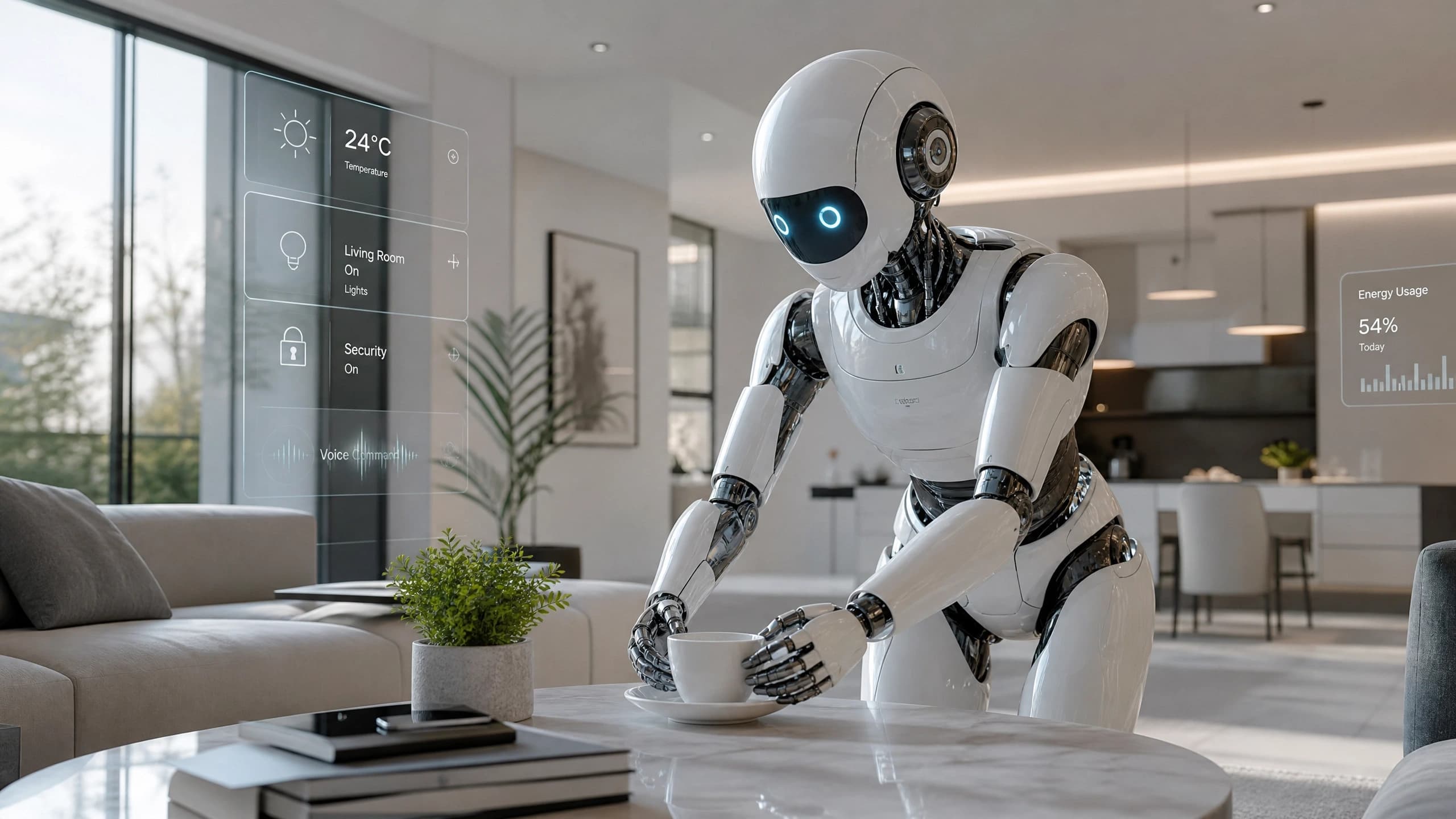
AI humanoid robots are set to expand the concept of home automation far beyond static smart speakers, automated lights, and single-purpose appliances. By acting as centralized, mobile operators for smart homes, these versatile household robots can physically bridge the gap between digital commands and physical chores—performing tasks like sorting laundry, cleaning surfaces, organizing spaces, and preparing simple meals. Moreover, their physical presence introduces a new era of home security monitoring, context-aware elderly assistance, and personalized care, turning our living environments into fully responsive, proactive ecosystems that cater to our physical needs.
Top Areas Where Physical AI Is Advancing
1. Humanoid Robot Mobility
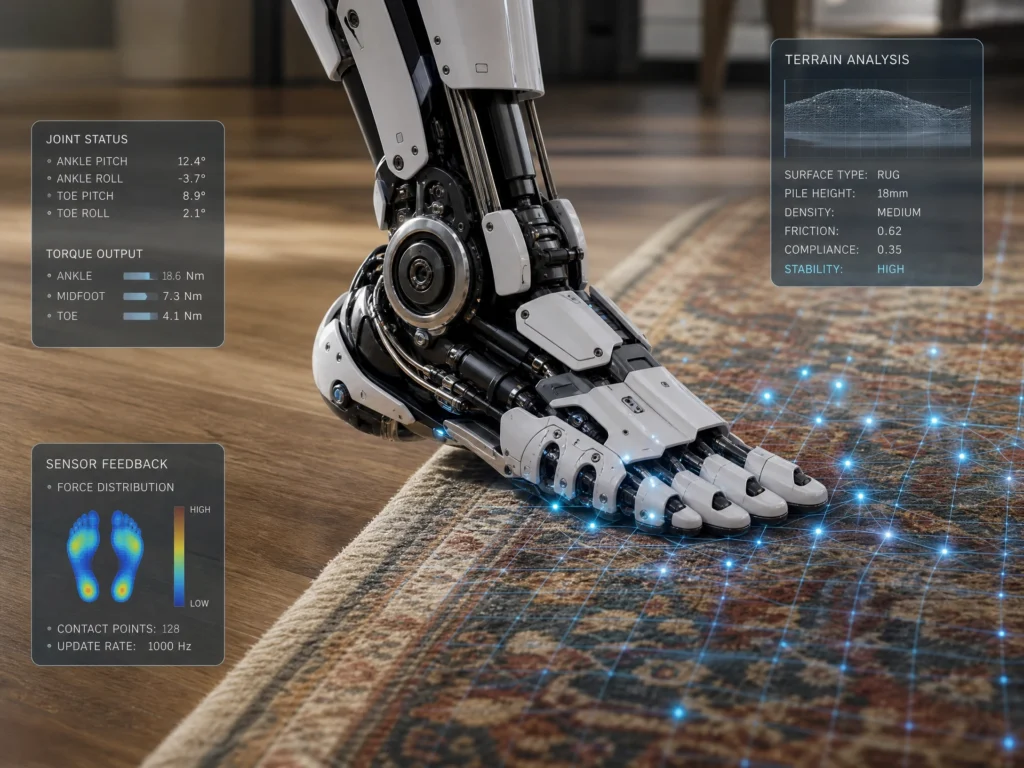
Humanoid robot technology has made quantum leaps in bipedal balance, walking mechanics, and real-time obstacle navigation over uneven terrain. Modern actuators and dynamic control algorithms allow robots to adjust their gait instantly when stepping on unexpected objects, navigating stairs, or transitioning between carpets and slick hardwood floors.
2. AI-Powered Household Robots
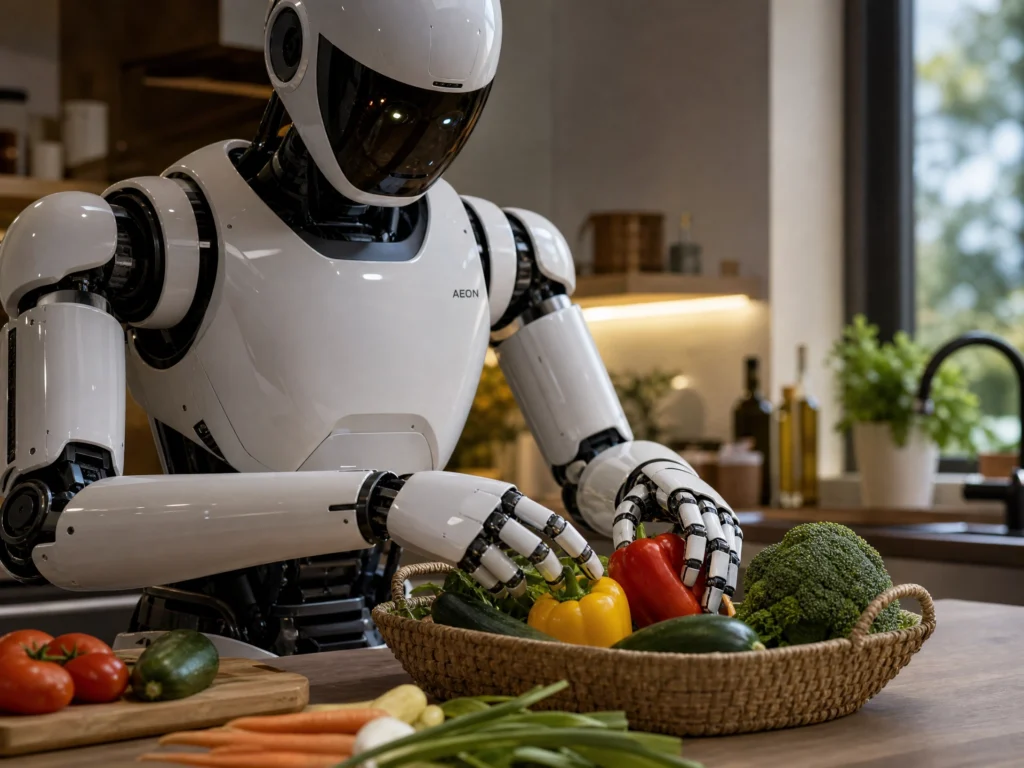
Emerging household robots are transitioning from pilot projects to domestic environments, focusing on the highly complex challenge of fine-motor manipulation. Using flexible grippers and high-density optical tactile sensors, these smart home robots are learning to handle fragile household items, open doors, fold clothes, and operate common kitchen appliances safely.
3. Bio-Inspired Robotics
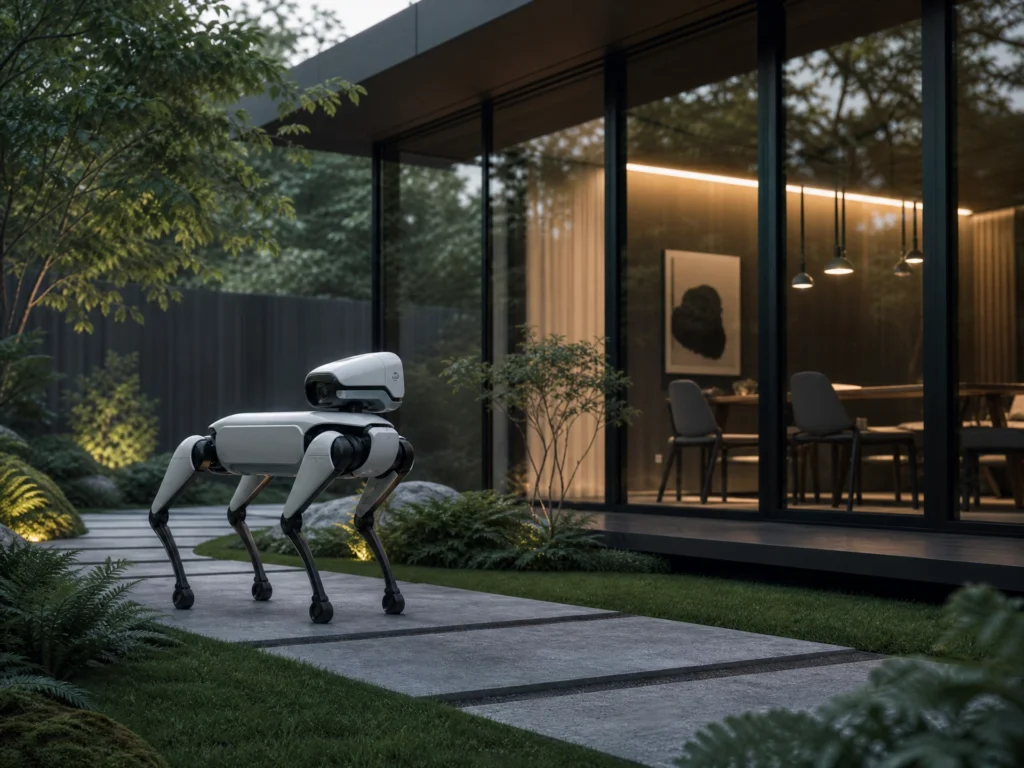
Bio-inspired robots mimic structural patterns, muscle designs, and locomotion mechanics found in nature to achieve unprecedented stability and energy efficiency. By studying the biological frameworks of animals, roboticists are developing lightweight materials, flexible joints, and resilient structural designs that significantly improve a robot’s overall agility and real-world durability.
4. Multi-Legged Robots for Difficult Environments
While bipedal structures are ideal for human-centric spaces, multi-legged robots provide unmatched mobility and stabilization in highly unstructured, rugged, or hazardous environments. These quadrupedal and hexapedal systems excel in industrial inspections, search-and-rescue operations, and outdoor terrains where wheeled platforms or humanoid legs face mechanical limitations.
5. Human-Robot Interaction
Advancements in natural language processing (NLP) and context awareness have revolutionized how human-robot interaction occurs in daily spaces. AI chatbots integrated into humanoid systems allow users to issue abstract commands like “clean up the spilled coffee” rather than step-by-step instructions, with the robot using visual cues and voice synthesis to clarify intent and report progress.
6. Autonomous Robots in Real-World Environments
To operate successfully outside controlled laboratory settings, autonomous robots must possess the ability to resolve unexpected physical conflicts independently. By combining continuous spatial mapping, computer vision, and predictive physics engines, these real-world robotics systems can dynamically plan new paths when an exit is blocked or recover gracefully from physical slips and drops.
7. Smart Home Robots and Connected Devices
The integration of smart home robots with the broader Internet of Things (IoT) ecosystem enables a highly coordinated approach to domestic management. Operating on unified communication protocols like Matter, an AI-powered robot can communicate directly with smart security systems, lighting setups, and connected kitchen appliances to optimize energy efficiency and streamline household routines.
8. Industrial Robotics and Consumer Robotics Convergence
The rapid commercialization of humanoid systems has created a unique technological transfer, where high-durability mechanisms from industrial robotics are being adapted for consumer robotics. Features like heavy-duty safety sensors, precision force feedback, and low-latency motor controllers are being scaled down and cost-reduced, making advanced robotics systems safe and economically viable for domestic spaces.
AI Humanoid Robots vs Traditional Home Automation
Traditional home automation is built around static, pre-programmed IoT environments where smart devices execute binary commands—such as turning off a light or scheduling a robot vacuum to sweep a flat surface. In stark contrast, AI humanoid robots powered by Physical AI introduce dynamic, context-aware physically embodied intelligence. Rather than requiring users to configure elaborate digital routines, a humanoid robot can navigate through complex three-dimensional spaces, manipulate physical objects of varying shapes and weights, and make autonomous decisions based on changing household situations, effectively transforming home automation from passive scheduling to active physical assistance.
Why Robot Mobility Is the Biggest Challenge
Despite rapid cognitive advancements, robot mobility remains one of the most formidable mechanical engineering hurdles in real-world robotics. Navigating a human home requires a bipedal system to continuously calculate gravity, friction, and balance while stepping over obstacles, negotiating narrow hallways, and managing transitions across varied surfaces. Managing this high-frequency physical computation demands massive onboard computational power and high-torque actuators, both of which severely drain battery life, limiting most current humanoid prototypes to brief operational windows before requiring a recharge.
The Role of Machine Learning in Robotics Technology
Machine learning has entirely revolutionized robotics technology by shifting the programming paradigm from manual task-action coding to end-to-end neural network learning. Through imitation learning, AI-powered robots can observe human operators performing chores via video or virtual reality and immediately replicate the motion dynamics. Furthermore, deep reinforcement learning allows robots to undergo millions of simulated training sessions in digital twins, enabling them to master complex physical interactions—such as gripping slippery objects or recovering balance—before ever deploying to physical hardware.
Benefits of AI Humanoid Robots
- More advanced home automation: Acts as a centralized, mobile hub capable of orchestrating and physically managing smart home environments.
- Support for household chores: Takes over physically taxing, repetitive, and time-consuming tasks like dishwashing, laundry sorting, and vacuuming.
- Better assistance for elderly or busy users: Provides proactive physical support, fall detection, medication reminders, and general mobility aid to vulnerable demographics.
- Improved smart home interaction: Replaces complex mobile apps with intuitive voice, gesture, and natural human-robot interaction.
- Physical help in real-world environments: Extends automation past digital screens to perform physical, real-world tasks in unstructured spaces.
- More natural human-robot interaction: Fosters intuitive, expressive communication through advanced AI chatbots, computer vision, and emotive feedback.
- Increased productivity: Frees up valuable human time by autonomously managing domestic maintenance and routine organization.
- New opportunities in consumer robotics: Drives market growth, cost reductions, and developer ecosystems for personal domestic applications.
- Better automation for businesses: Provides highly adaptable labor alternatives for administrative, customer service, and light logistics tasks.
- Innovation in future technology: Accelerates cross-disciplinary breakthroughs in materials science, battery density, mechanical engineering, and edge AI processing.
Challenges Holding Humanoid Robots Back
Several critical limitations must be resolved before AI humanoid robots can achieve mainstream domestic adoption, with high production cost and mechanical reliability topping the list. Current hardware configurations are incredibly complex and expensive to manufacture, requiring specialized actuators, precise harmonic drives, and extensive sensor suites that are prone to mechanical wear and require frequent maintenance. Additionally, safety is a massive concern; deploying a heavy, high-torque metallic machine alongside children and pets requires absolute collision avoidance guarantees, robust cybersecurity to prevent hacking, and strict data privacy protocols to protect the video and audio feeds captured by the robot’s cameras.
Are Home Automation Robots Ready for Consumers?
While single-purpose consumer robotics products like robotic vacuum cleaners, automated lawn mowers, and basic stationary monitoring devices are widely available and highly effective today, general-purpose AI humanoid robots are not yet ready for the average consumer market. Most advanced bipedal platforms remain in highly controlled pilot phases, research labs, or early industrial testing environments. Startups and major technology companies are actively testing beta prototypes in limited home trials, but a commercially viable, general-purpose domestic humanoid that can safely and autonomously manage a household remains several years away from mainstream retail availability.
Future of Robotics: What Comes Next?
The future of robotics will be defined by the seamless blending of Physical AI and advanced robotics systems into a unified, mass-produced reality. Over the next decade, we can expect the rapid development of specialized vision-language-action (VLA) models that allow AI-driven humanoids to possess a deeper semantic and causal understanding of the physical world. As production lines scale and component costs decrease, bipedal and bio-inspired robots will gradually transition from high-end corporate novelties to affordable domestic assistants, permanently reshaping our relationship with technology and how we structure our daily lives.
AI Humanoid Robots Checklist
- Can the robot move safely? Must possess redundant collision-avoidance systems and soft-contact mechanics to operate safely near humans.
- Can it understand voice commands? Needs advanced natural language processing to interpret abstract, context-rich spoken instructions.
- Can it recognize objects? Requires robust computer vision models to distinguish between delicate items, trash, and personal belongings.
- Can it operate in real-world environments? Must navigate dynamic, unstructured spaces without losing balance or requiring pre-mapped pathways.
- Does it integrate with smart home systems? Should support open smart home standards (like Matter) to coordinate with IoT devices and appliances.
- Does it protect user privacy? Must secure all continuous video, audio, and spatial mapping data with local edge processing and advanced encryption.
- Is it safe around children and pets? Needs real-time, low-latency sensory reflexes to stop motion instantly if a child or pet approaches.
- Does it support useful household tasks? Needs sufficient manual dexterity to manipulate doors, kitchenware, laundry, and cleaning tools.
- Is battery life practical? Must offer at least several hours of continuous operation on a single charge and possess self-docking capabilities.
- Is maintenance simple? Hardware modules should be easy to diagnose, repair, or swap out without requiring specialized robotics engineering.
- Is the cost reasonable? Production scaling must lower consumer pricing to a range comparable to a modest family vehicle.
- Is the technology commercially available or still a prototype? Check if the system is actively shipping to customers, in a limited beta test, or purely an experimental research prototype.
Final Thoughts
The convergence of AI humanoid robots, Physical AI, and smart home automation is actively carving out a future where physical chores no longer dictate the structure of our domestic lives. As machine learning models continue to master real-world mechanics and mechanical engineering overcomes the physical limitations of robot mobility, the line between digital convenience and physical automation will completely dissolve. While several hardware, safety, and economic challenges remain, the steady transition of these autonomous machines from industrial testing grounds to domestic living spaces promises to redefine our homes, bringing us closer to a truly collaborative era of human-robot coexistence.