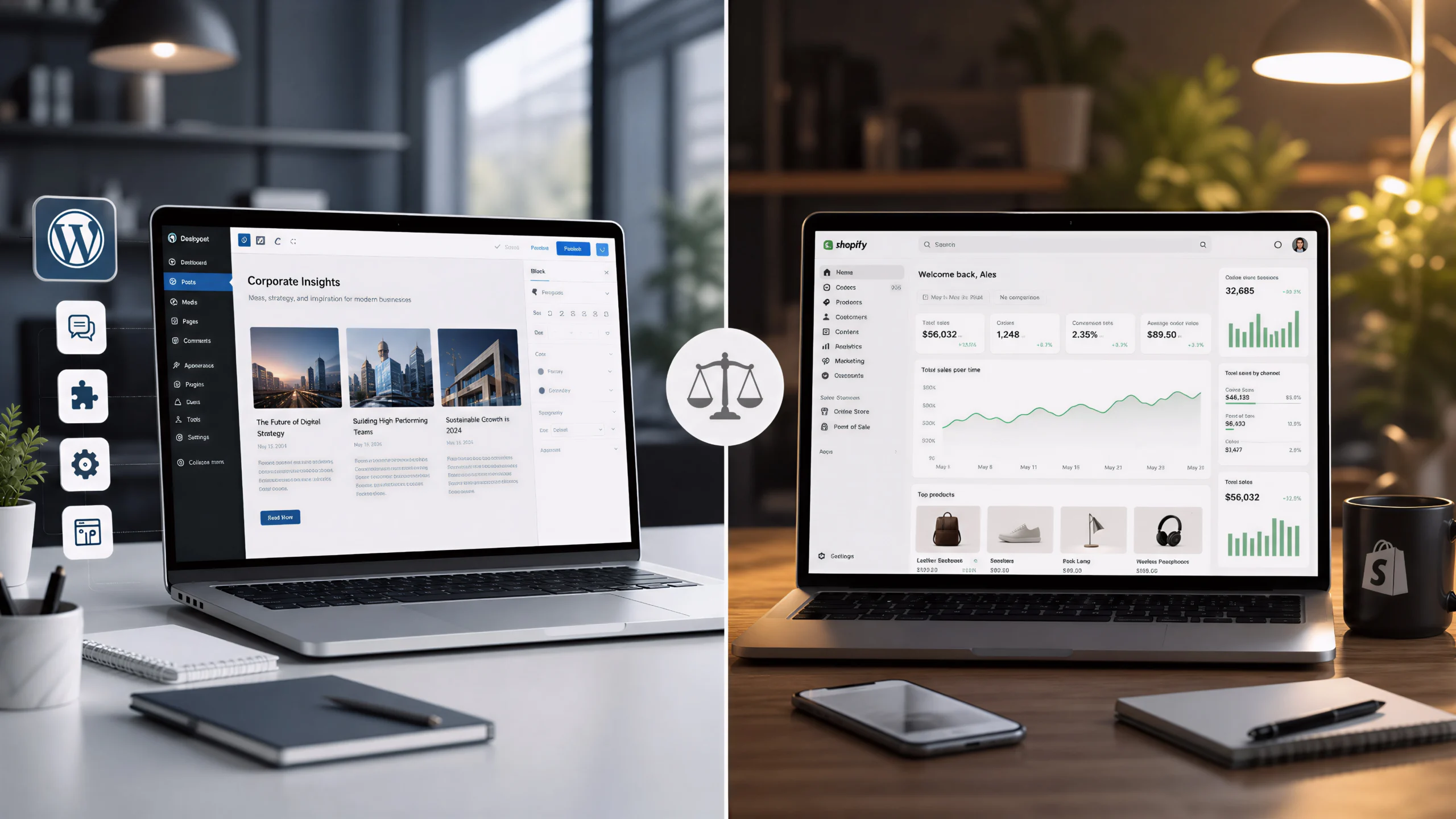
WordPress vs Shopify: Which Platform Is Best for Your Online Business?
Compare WordPress vs Shopify to find the best ecommerce platform for your online business based on SEO, cost, ease of use, and design flexibility.

Launching an online store is exciting, but the technical choices can quickly become overwhelming. Many business owners know they want to sell online, but they hit a wall of confusion when trying to decide between WordPress and Shopify. It is incredibly frustrating to stall your launch just because you are worried about picking the wrong foundation for your store.
Your platform choice is arguably the most critical technical decision you will make. It directly affects your initial setup cost, design flexibility, checkout experience, and available payment gateways. Over the long term, this single choice impacts your content marketing strategy, site security, scalability, and how much control you truly have over your business growth.
In this WordPress vs Shopify comparison, we will break down exactly how both platforms perform in the real world. We will look past the marketing hype to help you choose the best option for your online business, ensuring your foundation is built for sustainable growth and a seamless user experience.
WordPress vs Shopify: Quick Overview
Shopify is a dedicated software-as-a-service (SaaS) ecommerce platform. This means you pay a monthly fee, and Shopify provides the hosting, the shopping cart, and the infrastructure all in one package. It is built specifically to help business owners set up an online store quickly without needing to touch any code or manage complex server settings.
WordPress, specifically WordPress.org, is a free, open-source content management system that powers a massive portion of the internet. To turn it into an ecommerce platform, you use a free plugin called WooCommerce. While WordPress gives you complete ownership and absolute control over every pixel and function, it requires you to manage your own web hosting, security, and technical setup. The main difference comes down to a choice between simplicity and control.
Ease of Use: Which Platform Is Easier to Manage?

When you log into the Shopify dashboard, everything makes sense immediately. The setup process is highly linear, guiding you from adding your first product to configuring your taxes and shipping rates. Because Shopify manages the hosting and infrastructure, you never have to worry about server updates or technical crashes, making it an incredibly beginner-friendly experience.
The WordPress dashboard has a steeper learning curve because it is a broad content management system first. Setting up an online store means you have to install WordPress on your own web host, add the WooCommerce plugin, and configure the settings manually. While apps in Shopify are usually one-click installs, WordPress relies on plugins that sometimes require a bit of technical configuration to work perfectly together.
Design and Customization: Templates, Layouts, and Control
Shopify provides a curated selection of highly polished, mobile-responsive templates designed specifically for conversion. Changing colors, typography, and basic layouts is straightforward using their drag-and-drop editor. However, your layout flexibility is somewhat limited to what the theme allows, and customizing the actual checkout design is heavily restricted unless you are on their most expensive enterprise plan.
WordPress offers virtually unlimited design freedom. There are thousands of WordPress themes available, and with powerful page builders, you can customize every single aspect of your user experience. If you want full brand control and the ability to implement custom web development for unique layouts, WordPress is unmatched. You are never locked into a rigid structure, meaning your website can evolve exactly how you envision it.
Ecommerce Features: Checkout, Payments, and Store Management
Both platforms handle core ecommerce brilliantly, but they approach it differently. The Shopify checkout is highly optimized, trusted by millions of buyers, and incredibly fast. They offer their own built-in gateway, Shopify Payments, which is easy to set up. However, if you choose to use third-party payment gateways, Shopify charges additional transaction fees on top of your monthly subscription costs.
With WooCommerce on WordPress, your product management and checkout options are fully customizable. You can connect almost any payment gateway in the world, and WordPress never charges you transaction fees for making a sale. If you run a complex operation, like a dropshipping seller needing unique routing or a business requiring advanced subscription setups, WooCommerce plugins offer deeper customization than the Shopify app store.
Cost of Shopify vs WordPress
Pricing out an ecommerce platform is rarely as simple as looking at the sticker price. A cheap platform can become expensive if it limits your growth.
- Shopify: You pay a flat monthly subscription fee. However, costs rise when you add premium themes, paid apps for essential features, and potential transaction fees if you do not use Shopify Payments.
- WordPress: The core software and WooCommerce are free. Your basic costs include web hosting, a domain name, and an SSL certificate.
- Hidden Costs: WordPress costs can scale if you need premium WooCommerce plugins or custom development. Shopify costs scale as your revenue grows and you require higher-tier subscription plans.
Shopify vs WordPress SEO Comparison

If search engine visibility is a major part of your growth strategy, the Shopify vs WordPress SEO comparison is crucial. Shopify covers the on-page SEO basics very well. You can edit meta titles, meta descriptions, and URLs, and the platform automatically generates XML sitemaps. However, Shopify locks down certain technical aspects, making it difficult to fully customize your site structure, URL hierarchy, or advanced schema markup.
WordPress is widely considered the gold standard for SEO control. Because it was built as a blogging platform, its internal content structure is perfectly aligned with Google’s preferences. With powerful SEO tools and plugins, you can optimize product page SEO, control category page SEO, edit meta tags perfectly, and implement advanced technical SEO strategies. You have total freedom over crawlability and indexability, giving you the edge in competitive search intent battles.
Blogging and Content Marketing
A strong content strategy builds topical authority and drives organic traffic. WordPress blogging strength is legendary; it provides the best text editor, categorization, and media management available. If you are a blogger wanting ecommerce features without losing SEO control, or a brand that relies heavily on articles and guides to educate buyers, WordPress is the absolute best choice for your ecommerce content strategy.
The Shopify blog feature is functional but basic. It allows you to publish articles, but it lacks the advanced structuring, custom taxonomies, and rich content blocks that WordPress offers. For businesses that focus primarily on advertising and fast product sales, the Shopify blog is usually enough. But if your business model relies on deep, structured content to attract users, Shopify will eventually feel restrictive.
Apps, Plugins, and Platform Ecosystem
No platform does everything perfectly out of the box, which is why ecosystems matter. The Shopify app store is tightly regulated, meaning apps are generally secure, easy to install, and integrate smoothly with your dashboard. However, you often have to pay monthly fees for each app, which can quickly inflate your operating budget.
The WordPress and WooCommerce ecosystem is massive, offering tens of thousands of free and paid plugins. You can build completely custom features for a fraction of the cost of Shopify apps. The downside is plugin quality varies. Installing too many poorly coded plugins can slow down your website performance and create security vulnerabilities, making responsible curation essential.
Security, PCI Compliance, and Maintenance
Security is non-negotiable when handling customer data and payments. As a SaaS infrastructure, Shopify handles all the heavy lifting for you. The platform is inherently secure, automatically updates itself, and provides a fully PCI-compliant checkout out of the box. You never have to worry about backing up your database or patching security holes.
WordPress requires you to take an active role in your own security. You are responsible for keeping the core software, your theme, and all plugins updated. You must also ensure your hosting security is strong, set up 2 factor authentication, and manage your own backups. While you can achieve a perfectly secure and PCI-compliant WooCommerce store, the maintenance responsibility falls entirely on your shoulders or your web development agency.
Shopify Alternatives: When WordPress Makes More Sense
Sometimes businesses default to Shopify because it is heavily marketed, but there are strong Shopify alternatives depending on your business model. WordPress ecommerce through WooCommerce is the most powerful alternative when you need long-term platform independence.
WordPress makes more sense for content-heavy stores, SEO-focused businesses, and companies that sell highly complex or restricted products. If you want full ownership, lower long-term platform dependency, and the ability to customize your checkout without paying enterprise SaaS fees, WordPress is the superior strategic choice.
Which Is Better Shopify or WordPress for Small Business?
The best platform is not the most popular one. It is the one that fits your business model. For small business owners deciding which is better Shopify or WordPress for small business, the answer lies in your immediate resources and long-term goals.
If you have a limited technical background, want to launch a store quickly, and value ease of use over deep customization, Shopify is better. If you have specific SEO goals, want total control over your digital assets, and plan to scale a content-rich brand, WordPress is the stronger choice.
Common Mistakes When Choosing an Ecommerce Platform
Many business owners make critical errors during the platform selection phase that slow their business growth later on. Avoid these common mistakes:
- Choosing a platform based solely on the monthly subscription price while ignoring transaction fees.
- Selecting a platform without evaluating how well it supports your long-term SEO and content marketing strategy.
- Installing too many apps or plugins, which ruins website performance and page experience.
- Picking a template because it looks pretty, rather than ensuring it is built for conversion rate optimization.
Final Verdict: WordPress vs Shopify
There is no universal winner in the WordPress vs Shopify debate. Shopify is an incredible tool for simplicity, speed, and hands-off technical management. It lets you focus purely on marketing and selling. WordPress is an unmatched powerhouse for control, SEO flexibility, and content creation. It ensures your ecommerce platform supports your business rather than trapping it. Evaluate your budget, your technical comfort level, and your reliance on organic search traffic to make the final call.
How AXVOI Can Help You Build the Right Ecommerce Website

Choosing between platforms is just the first step. At AXVOI, we act as your dedicated growth partner, helping you turn that platform into a conversion-focused machine. Whether you need an easy-to-manage Shopify store setup or complex WordPress ecommerce development, our team aligns the technology with your business goals.
We specialize in ecommerce website development, advanced SEO strategy, and custom web development. From optimizing your user experience to integrating AI automation and digital marketing campaigns, AXVOI builds online business growth systems that scale seamlessly. We ensure your website is fast, secure, and designed to turn visitors into loyal customers.
Conclusion
Choosing the right foundation for your online store is a major decision that impacts every facet of your digital operations. Ultimately, the WordPress vs Shopify debate boils down to your specific business goals, budget, technical resources, and growth strategy. Shopify delivers unmatched simplicity and an effortless setup, making it ideal for those who want to launch fast and leave the technical maintenance to someone else. WordPress, powered by WooCommerce, offers unparalleled control, superior SEO flexibility, and limitless customization for brands willing to manage their own digital real estate. Take the time to evaluate your long-term content needs, your checkout requirements, and your budget to confidently select the platform that will best support your success.